Showing posts with label animals. Show all posts

Friday, 7 September 2012

Merri Creek

Thursday 6th September.

We have recently extended the boundaries, for both the space that we can explore, and the types of activities that we can do. We agreed that climbing trees is ok, as long as we don't go higher than Nerida's head, and only use branches that are thicker than our wrists. 


A group of children were extremely concerned about rubbish floating in the water, so we also extended our boundary a little to the edge of the creek, as long as a teacher is present.


The children were combined their fascination with building (and any kind of large stick) and a concern for safety and made a 'hand rail' leading from the top of the hill to the edge of the bank, so that they knew they would be able to climb up again. The children also tried making a bridge across the creek, but were unable to find a stick long enough. 


Once we go there, it took quite a while to 'fish' for the polystyrene foam floating up and down the water. This was complicated by the fact that the foam kept changing direction, floating one way and then another. The children decided this was because of the currents and the wind.


After retrieving the rubbish, we tried measuring the depth of the creek, using sticks that we found along the bank and in the water. This was difficult, because many of the sticks were already wet, and so didn't show the point that they had been dipped to. Others were drier and so clearer to see, and we made some approximate measurements using these. 

The children are also becoming increasingly fascinated by small details that they find on the plants. Here are a few of their observations:


It feels like soap
It feels like white chocolate to me.
It feels like a kind of silkish, soapish, um...
And it smells weird. 


More patterns! It might be worms 


I know this is wood worm because of the holes 


Why are there all these scratches?
It might be possums or squirrels.
It must be possums because squirrels live in England. 


This plant has been eaten. I think it's caterpillars because they eat the leaves. 


They are also becoming very keen photographers, it's fascinating to see the things that they observe. Here are a few of the photos of which they are most proud:


Look, it's got purple! 


Thank you to Michelle, Mia, Katie and Jeremy who came along with us this week. Thank you also to the little brothers and sisters who came along with the big kids.

Philosophy - “The Giving Tree” by Shel Silverstein

We have been looking at The Giving Tree over the past couple of weeks both for philosophy and for our inquiry into survival. Here are some responses to the book:


That’s a sad story, because the boy killed the tree.

Why did it keep saying that the tree was happy?
  • The tree was offering.
  • The tree changed her mind. He chopped down her stump and then she was just a stump and she wasn’t happy.
  • The tree was happy even though it was cut down because she wanted the boy to live, that’s why she was happy.
Also as part of philosophy and our inquiry into survival, we are exploring and reflecting upon our rights and responsibilities and the rights of nature. I was amazed at the children’s understanding of our rights in our first discussion of what our rights are (apart from talking about our right to learn and our right to feel safe).

What are our rights?
  • We have the right to play
  • We have the right to build houses
  • We have the right to run
  • We have the right to eat and drink
  • We have the right to sleep
  • We have the right to a home
  • We have the right to have pets.
  • I think us and trees and nature have the same amount of rights
  • I think people have the right to do anything
  • We have the right not to kill nature
  • We don’t have the right to starve people
  • We don’t have the right to kill nature
  • We have the right to eat
  • We have the right to build cubby houses in trees
Discussion about one child’s claimed right – Do we have the right to have pets?
  • Human beings have the right to have pets ‘cause people need guide dogs to guide them ‘cause they might be blind.
  • Same as child x because I have a cat at home; because if you get bored you can play with them.
  • We have the right to hold pets but only if you ask the owner. You can’t take them from someone else.
  • I don’t agree - I don’t have a pet.
  • You have the right to get pets from the pet shop because they sell them and it’s all right to get them.
  • We have the right to have pets because I have (several animals) and my mum bought them with her own money... they were saved by people. They were sick or something. I think that we have the right to have pets because if we don’t they might get sick or die.
Do we have the right to keep birds in cages?
  • I think we have the right to keep birds in cages if the windows or doors are open.
  • We don’t have the right to keep them in cages because then they can’t fly around and they don’t have fresh air.
  • We do have the right to keep birds in cages because some cages are only metal squares and they can get fresh air and still fly around a bit.
  • I think we don’t have the right to keep birds in cages ‘cause if they’re in cages they don’t have much room. 
  • If we keep birds in cages, and we forget to give them water or food, then they’ll die (thus, we are making them dependent on us for their survival).
  • We can keep birds in cages if they are endangered because then we can protect them and keep them safe. 
We then spoke briefly about protected breeding programs and then releasing them back into the wild.

What are our responsibilities if we do keep pets?
  • We have to give them drinks, food, and names because, like for rabbits, they need this little bottle that has a tube, and if we don’t let them have any of that, food or drinks or names, they’ll die.
  • You can have pets because they need help from humans, like food. Our responsibility is to give them food and water.

Wednesday, 22 August 2012

The Leadbeater Possum (aka. Fairy Possum)


We watched a video (there was a link to it from the Melbourne Zoo website – Act Now). We will need to return to it as an amazing conversation took over the session part way through. Below is a snapshot of this conversation.

We paused the video part way through and made predictions. My main question was: What might their threats to survival be?
  • Poisonous spiders like white tails and red backs.
  • They shouldn’t live near rivers because they might drown.
  • Rubbish and cats. Cats because they come out at night. People throw it on the ground and they might eat it. 
  • Owls because they’re birds and they’re nocturnal.
  • Eagles ‘cause they live in trees, and falcons. Birds of prey. 
  • We don’t have them in Australia.
  • Maybe some foxes that come out at night.
I then explained how they were introduced and we had touched on this topic briefly when we read The Rabbits by John Marsden and Saun Tan.
  • We should kill them! 
  • That’s a terrible thing! 
  • They’re part of nature. 
  • Well then we should send them back to where they came from. 
  • That would be mean ‘cause they would just like whichever country they would be in. 
  • You should actually send them back because if we don’t they’ll keep killing our creatures and then they’ll come extinct. 
  • I think we should just put a fence between the animals but the foxes might climb the fences.
  • Grow some carrots in a big fence and then grow some food outside so they don’t eat all of our plants. 
In our Community Bush Walks, some children have been interested in weeds, introduced plants and natives. Thus, a link is emerging. It is so interesting and exciting!

Sunday, 29 July 2012

Our excursion to the zoo

On 26th July 2012, the survival movement group and terrace zoo group had an excursion to the Zoo.

What an exciting day it was! Even the forecast of rain couldn’t dampen our spirits (though the wind was fiercely cold!) 


We started by eating – that’s always a good place to begin! As we sat down in a pavilion, we heard a ferocious roar! Was it my stomach? No, it was the lions! They put on quite a show and we rushed over there as soon as we finished eating, but disappointingly, the lions were nowhere to be seen. Did you know that it’s the females that hunt for food, not the males? Their role is to protect the pride. We also looked at the African Wild Dog, which is endangered due to disease and hunting. 

Next we had our lesson with zookeeper Kat. She introduced us to a Red Tailed Black Cockatoo named Sam. His species is endangered because it needs really big old trees to live and they take a long time to grow and people keep chopping them down. 

She taught us that animals need a few things to survive: food, water (or milk for babies) and shelter. Some animals need friends to pick nits – this provides food and stops animals from being itchy!!!

Pueblan Milk Snake 


Then we met a Pueblan Milk Snake, named Jaffalito. Here are some things that the Preps said (in quotation marks):
  • “Some snakes can dig holes” for shelter 
  • “What’s venom?” “it’s a kind of poison stuff” 
  • “We are mammals!” (after Kat said that snakes eat small mammals) 
  • “The scales feel soft” 
  • “It has a forked tongue” (Kat – it’s two tongues stuck together) 
  • “He’s smelling the air!” (Kat – he’s actually tasting the air! He can taste you!) 
  • The Pueblan Milk Snake doesn’t hiss “because then an American might find it!” (its habitat is South America) 
  • “How come they’re going under that wood (bark)?” (Kat – to hide from predators. Also, snakes don’t have eyelids so they have to go somewhere dark to sleep.) 
Kat spoke about how people chop down trees for paper, thus destroying their habitat. 


Green Tree Frog

Then we met a Green Tree Frog, named Bashful. Here are some things that the Preps said about him:
  • “He can camouflage”
  • “He feels strong and soft”
  • “A bit gooey, and his legs are gooey”
  • “He can drink through his whole body” 
Kat spoke about a threat – the chemicals from our cleaning products that go down drains and into their habitat. Thus, we have a responsibility to choose cleaning products in a more conscientious manner.

After the lesson, and in between meals, we got to see lots of animals. Below are some more quotes from the children and snippets of information.

Tortoises

Under threat from feral animals
Why do they have shells?
  • “They (tortoises) might see a gun and they’ll (the hunter) think it’s a rock” 
  • “They need to hide” 
  • “So they have shade” 


Seals 

  • “Their threats are sharks” 
  • “Yeah, and when they’re on the snow, their threats are people” 

Other 

  • “apes are like people” 
  • the rat enclosure has trees “so it can camouflage” 
  • Pelicans have long, big beaks “To fit lots of water in, or fish” 

Elephants

Then we met a zoo keeper feeding the elephants. She told us that: 
  • Their thick skin and the dirt/dust mean that insects can’t bite them. 
  • The dirt exfoliates their skin and acts as sunscreen. 
  • Doesn’t lie down – would make it too vulnerable 
  • Only picks and eats the big branches, thus allowing light to enter the forest and leaving the smaller things for the smaller animals. 
  • The tusks are for eating, fighting and digging – only males have them. 


In summary, some of the threats to survival that we learnt about today include:
  • hunting 
  • disease 
  • loss of habitat, such as chopping down trees 
  • feral animals 
  • pollution, such as chemicals and litter 
  • predators. 
Some of the strategies that animals use to survive include: 
  • camouflage 
  • tusks 
  • shells 
  • hiding 
  • living in packs/with friends 
  • fighting 
We are excited about continuing our inquiry into survival.

Thursday, 28 June 2012

Movement and Survival

Below are some snap shots from planning documents and recorded quotes and conversations relevant to what has been happening lately in Inquiry for the ‘Natural Movement’ group working with Nerida.

23rd May

Discussing why it is interesting or important to explore the movement of the various things in the drawings that children did at the start of our inquiry. For some reason, the interest in movement evolved into a fascination with survival! Here are some key quotes from the children:
  • If we didn’t have any water then we would die.
  • If we didn’t have water, our land would be dry.
  • If we didn’t have any sea creatures then there wouldn’t be any museums.
  • Because if we didn’t have any planets we wouldn’t have a home.
  • You shouldn’t actually catch dangerous animals because otherwise they’ll kill you and they weren’t always dangerous – sharks were like… great white sharks, you shouldn’t catch those things ‘cause otherwise they’ll try to kill you. And they weren’t dangerous but now they because dangerous because you’re hurting them.
  • If you didn’t have water, you wouldn’t have anything to eat ‘cause living things live in water and you catch them to eat and if you don’t you’ll die.
  • I drew snakes, well, some of them could be dangerous. We do know one things anyway – some things have red and that’s a warning sign – if you see a snake with red, then stay away. Only if they’re scared they’ll bite you.
  • If there was no sea creatures, you could still live, it’s just you can eat meat from other animals that don’t need water, that don’t live in water; and you can catch dangerous sea creatures because they can’t breathe out of water.
  • Some sea creatures have to come up out of the water to have a breath.
  • If you didn’t have a sun, the earth would be… no body could live on it.

31st May

Track the movement of the sun – trace shadows with chalk.
  • The shadows will get longer at the end of the day. That’s what happens at the end of the day.
  • The Sun makes your shadow. The Sun gets colder and colder and the shadows get longer and longer.
  • If we stand far away then it will just like change. What if it’s bigger?
  • He accidentally made this arm shorter than it actually is.
  • When I stretch my arms out, it looks like this one’s a little bit longer.
  • Yeah, one is a little bit longer.


18th June 


19th June 

Thinking Routines to go prompt deeper thinking.
Resources: Lots of images relevant to survival, eg. animals fighting, fleeing, camouflage, drought, hunger, etc.

“See, Think, Wonder” - in pairs, find someone with the same image as you. Discuss what you can specifically see in the image, what you think is happening in the image and what you wonder.

Dog and Crab 

photo of a brown dog facing a large crab
think
- I think the crab’s claw chopped the dog’s body off.
- And when the crab eats the dog, the crab’s going to choke.
- And I think that the crab might not survive.
- Yeah, me too.


Whale in a net

A photo of a whale's snout poking up out of the water, with a net draped over the whale.
see 
- I can see blood.
- I can see blood and a net.

think
- I think that maybe a pirate stuck his sword in there and then put a net over the top.
- I think the same.
- I think that a pirate jumped off a ship with a… and pulled it over the top and threw it over him. 

wonder
- I wonder if the crew is going to run over him.
- I think the blood’s really hurting ‘cause of the water.


Duckling on dried-up lake

A photograph of a dead bird on dry, cracked earth.
(Two children use magnifying glasses to examine their image.)
see
- A wing, there.
- And a crack, there.
- Yeah, crack’s in the ground.
- A canyon!


think
- Maybe it was flying but then it lost balance and fell down.
- If it was dead, something could have poisoned it, like a snake.
wonder
- I wonder if the bird is still alive.
- I wonder if it’s going to survive.


“Move and Reason” – in two groups, with all images in the middle of the circle. Which images do you think go together? Why?
  • They both look like they’re fighting. 
  • I think this one and these ones go together because they’re all dead.  
  • I’ll put that one there because they’re all in danger.
  • I think this one and this one belong together because they’re both dead.
  • These two, because they’re both skeletons. (How do you think they died?) A human killed them.


Friday, 11 May 2012

Aquarium Excursion part 2

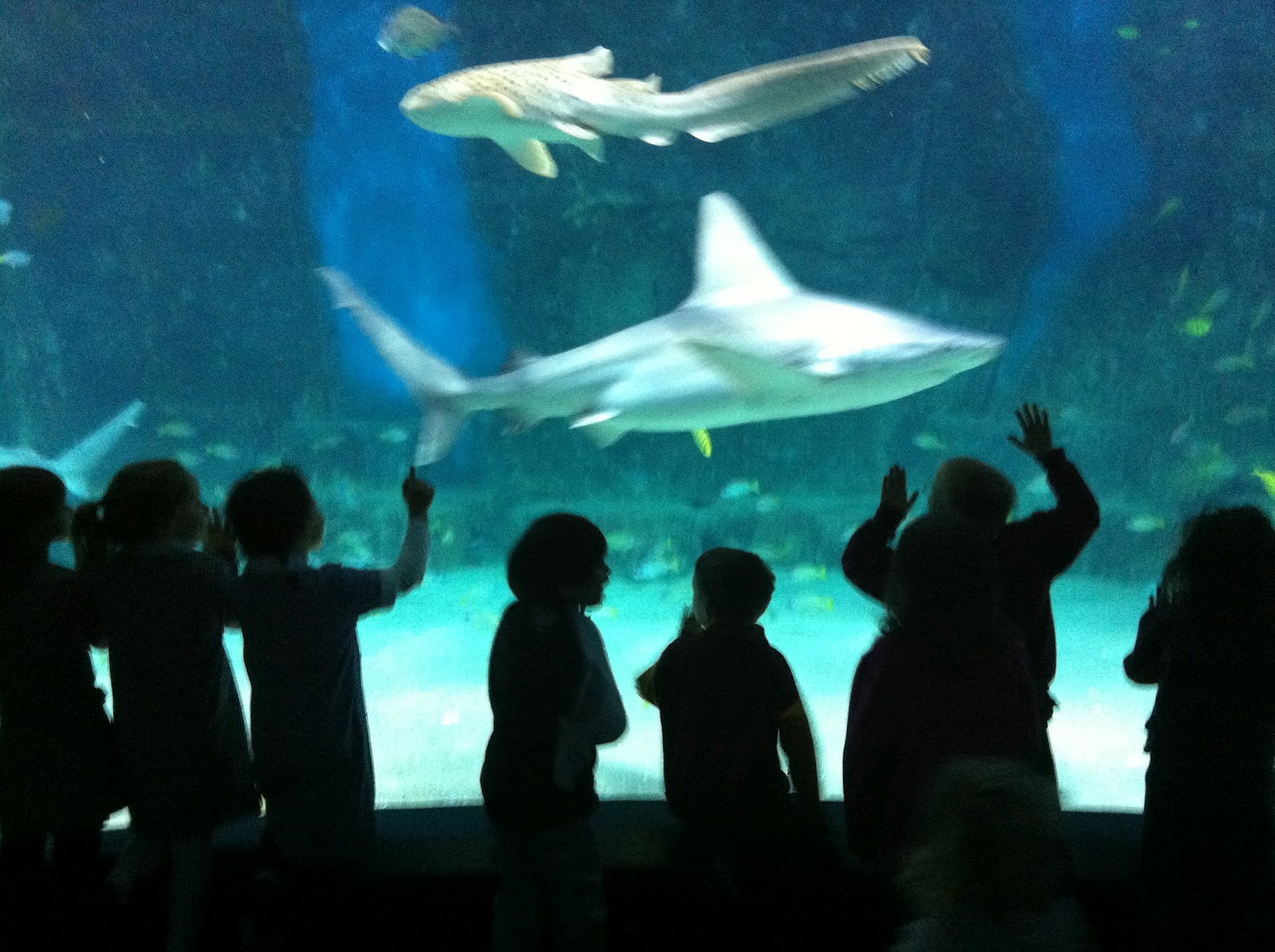
On Friday 4th May 2012, the Bicicletta LC went to the Melbourne Aquarium...
(click on the images below to see them at full size)

The Penguins

"The penguins can slide."

"See? That one had a stream of bubbles coming off its back!"

"Look! Air bubbles up in the rock!"

“They come out of the penguin’s bottom!” (referring to the air bubbles)

“They get stuck in the dents of the rock!”

“See that one? He had air bubbles all over his back.”

“That one’s quite shiny.”

The Sea Stars and Sea Biscuits

“It felt slimy”
“It looks like a leaf”
“They feel spikey”
“They felt scaly”
“It felt like warm, soft in bed”
“It’s called a sea star because it can’t swim”


Reflection back at school: sharks, stingrays and eyes

“I saw the shark and was closed his eyes and he was sleeping walk, but shark is still sleeping because he have to swimming. And he do it slowly, slowly and swimming.”

“When sharks sleep they open their eyes and they still float on the water except they go really slow. Starfish’s eyes are on their backs.”

“I learned that sharks have eyes on their cheeks.”

“On Stingrays their eyes are on the bottom of their body and at the very end of their fins they’ve got poisonous, I don’t know what it is... stingers? And you can only touch them in certain places. And also their gills are on the bottom.”

“The stingrays’ eyes are on its head.”

“They’re both right because the stingray’s eyes are on the top and the bottom.”

“I know because I crouched down and I looked on the top and I saw nothing that looked like eyes.”

Drawing at the aquarium...

“I can’t describe how they move because they move so slowly,” referring to the small, long fish.

and adding water colour back at school.

“It’s blurry ‘cause it’s moving so fast,” referring to the blurry effect the water had on the colour in his drawing.